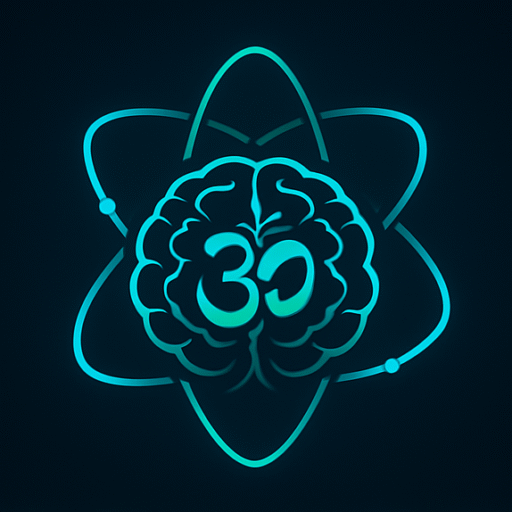
VEDANTUM is an intellectual and contemplative initiative dedicated to exploring the fundamental nature of reality, consciousness, and existence through an integrated dialogue between ancient wisdom and modern science.
The name VEDANTUM itself represents a synthesis:
Veda + Quantum –> VEDANTUM
a meeting point where Vedantic philosophy, quantum physics, neuroscience, and consciousness studies converge to investigate the deepest questions of life, universe, and awareness.
VEDANTUM seeks neither blind traditionalism nor reductionist scientism; instead, it pursues a harmonized understanding of truth grounded in rational inquiry, experiential insight, and philosophical depth.
Philosophy Encoded in the Logo
The Vedantum logo is not merely visual identity — it is a symbolic map of reality itself.
Electron Orbit — The Cosmic Observer
The outermost orbital structure represents an electron in motion.
In quantum physics, the electron embodies duality — simultaneously particle and wave. Its existence becomes meaningful only upon observation. This symbolizes the profound philosophical insight:
The universe emerges through observation.
- The orbit therefore represents:
- Quantum duality
- Observer–observed relationship
- Emergence of reality
- Higher‑energy physics and cosmology
The “observer electron” metaphorically signifies consciousness leaping into manifestation — the universe becoming aware of itself.
The Brain (Mind) — Seat of Perception
At the middle layer appears the outline of the human brain, representing:
- Neuroscience
- Cognitive science
- Consciousness studies
- Psychology of perception
Here arises the fundamental philosophical paradox:
Who observes?
What is observed?
The brain (mind) becomes the bridge between:
- matter and consciousness,
- perception and reality,
- experience and existence.
Vedantum studies consciousness not only spiritually but also scientifically — as the meeting ground of neuroscience and metaphysics.
Om (ॐ) — The Primordial Core
At the center lies Om, the primordial vibration (Pranava).
In Indian metaphysics, Om is understood as Nāda Brahma — the cosmic sound from which existence unfolds.
It represents:
- ultimate unity,
- the supreme truth consciousness,
- non-dual reality,
- the source underlying all phenomena.
Thus, the logo moves inward from cosmos → cognition → consciousness.
Symbolic Typography of VΣDΔNTΩΨ
The wordmark itself carries philosophical meaning through scientific symbolism:
E → Σ (Sigma)
Represents summation, integration, and wholeness — the unity of all knowledge systems.
A → Δ (Delta)
Symbolizes transformation and evolution — intellectual and spiritual change.
U → Ω (Omega)
Denotes completion, ultimate limits, and cosmic culmination.
M → Inverted Ψ (Psi)
Psi represents wavefunction and consciousness. Its inversion symbolizes the Vedantic insight:
“Eko’ham Bahusyām” —The One becoming many. Consciousness descending into individuality and manifest existence.
Purpose
Intellectual Scope of Vedantum
Vedantum functions as a philosophical and scientific contemplative platform where diverse streams of knowledge are studied in coordination.
Core Areas of Study
- Comparative philosophical inquiry
- Translation and interpretation of ancient primary texts
- Study of comparative religion
- Inner culture and practical self-development
- Reconstruction and reinterpretation of Vedic intellectual traditions
- Scientific and metaphysical analysis of consciousness
Metaphysical Integration
Vedantum promotes an expanded synthesis of global wisdom traditions through:
- Indian philosophical systems – Vedanta, Yoga, Sankhya, Nyaya, Mimansa & Vaisheshika etc.
- Buddhist and Jain philosophy
- Greek philosophical traditions – Pythagoras, Parmenides, Socrates, Plato, Aristotle, Neoplatonism etc..
- Modern Western philosophy – Rationalism, Empiricism, Phenomenology, Existential inquiry
- Comparative theology and religious studies
The aim is not comparison for contrast, but integration for understanding.
The Guiding Principles
Vedantum stands upon two guiding principles:
1. Systematic Study of Life’s Fundamental Questions
Human existence raises enduring problems concerning reality, mind, ethics, suffering, and meaning. Vedantum approaches these questions through disciplined philosophical and scientific investigation.
2. Harmonization of Knowledge Traditions
True understanding emerges when:
- rational intellect,
- scientific methodology,
- and inner experiential realization operate together.
Vedantum therefore seeks a reality grounded both in scientific rigor and inner experiential awareness.
A Scientific–Spiritual Approach
This platform represents a philosophical yet scientific spiritual initiative, dedicated to:
• Consciousness research
• Philosophy of science
• Quantum interpretations of reality
• Spiritual psychology
• Cultural and intellectual renewal
Vedantum encourages inquiry where science refines understanding and philosophy gives meaning, while spirituality provides experiential depth.
The Core Purpose
Vedantum ultimately aspires to become:
A meeting space where the universe, mind, and consciousness are studied as expressions of one underlying reality.
It invites thinkers, seekers, scientists, philosophers, and learners to participate in a shared exploration of existence — bridging quantum reality and Vedantic insight, observer and cosmos, knowledge and realization.
-
When Space Dissolves into Time: Quantum Physics Arrives at an Ancient Threshold
There is a particular kind of intellectual vertigo that strikes when two entirely independent traditions of inquiry converge on the same conclusion from opposite directions. Physics is currently experiencing exactly this. Recent research into holographic duality demonstrates that gravitational spacetime can emerge from an enormous number of entangled qubits —…
-
Advaita Vedanta and QIH Cosmos: Toward a Non-Dual Nature of Reality-02
Part -2: Maya, Pratibimbavada, and the Non-Dual Nature of Appearance In previous article we discussed that physics does not merely describe the world; it begins to reveal the process by which the world appears. If one follows this line of inquiry further, the transition from physics into philosophy is no…
-
Advaita Vedanta and QIH Cosmos: Toward a Non-Dual Nature of Reality-01
Part 1: Quantum Information Holography and the Emergence of Spacetime Reality, when approached through the lens of modern quantum theory, no longer begins with particles or objects, but with structured information encoded in mathematical form. At its foundation lies the qubit, a two-state system that does not exist as a…
-
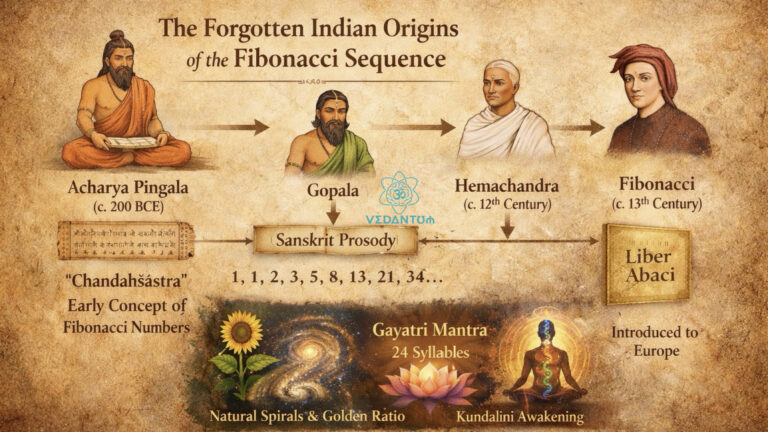
The Forgotten Indian Origins of Fibonacci Principle
In the previous discussion, we explored how spiral growth patterns in nature—from DNA helices to galaxies—often align with what modern mathematics calls the Fibonacci sequence and the Golden Ratio. However, an important historical clarification enriches this story and connects it even more deeply with the intellectual traditions of India. The…
-
The Spiral Code of Reality: Fibonacci to Gayatri Mantra
Reality, when examined across scales, reveals a remarkable continuity of pattern. Whether one observes biological life, atomic motion, or cosmic structures, nature repeatedly expresses itself through spiral and vortical geometry, suggesting that existence evolves according to an underlying mathematical and conscious order. The modern scientific world encountered this mystery vividly…
-
Biophotons, Consciousness, and the Spirit: Bridging Neuroscience and Indian Philosophy -01
Part I: Scientific Perspectives on Biophotons and Consciousness Recent scientific explorations have unveiled that neurons in mammalian brains emit photons, termed “biophotons,” spanning wavelengths from near-infrared to ultraviolet. This phenomenon has led to hypotheses suggesting that these biophotons might play roles in neural communication, potentially influenced by quantum entanglement, and…