
There is a particular kind of intellectual vertigo that strikes when two entirely independent traditions of inquiry converge on the same conclusion from opposite directions. Physics is currently experiencing exactly this.
Recent research into holographic duality demonstrates that gravitational spacetime can emerge from an enormous number of entangled qubits — that the geometry we call “space” arises not as a fundamental given, but as a large-scale structure precipitated from quantum information. More provocatively, time itself may be not a fundamental entity but an emergent phenomenon arising from the complex interplay of quantum information dynamics — the perceived flow of time reflecting the increasing complexity of the quantum state of the universe. [1]
Read that again slowly. Space is not fundamental. Time may not be fundamental either. What underlies both is something that behaves like pure relational information — patterns of entanglement in a substrate that has no classical geometry at all.
The Upanishads said something structurally identical, in a different language, approximately three thousand years ago.
The Physics: What the Qubits Are Revealing
The claim that space emerges from quantum information is no longer speculative philosophy. It sits at the productive edge of theoretical physics, undergirded by the AdS/CFT correspondence — a rigorously tested framework showing that gravitational dynamics in a bulk spacetime can be completely encoded in quantum information on its boundary.
In holography, quantum information theory provides a crucial tool that directly connects the microscopic structures of quantum many-body systems to the geometries of gravitational spacetimes. The entanglement entropy in such systems can be calculated from the area of an extremal surface in the corresponding gravitational spacetime — implying that the microscopic structure of spacetime in gravity may be regarded as the collection of entangled qubits. [2]
What this means philosophically is stark: space is not where things happen. Space is a consequence of how information is structured. The geometry emerges from the entanglement. Destroy the entanglement and the geometry dissolves.
But what of time? To address the fundamental question of how time emerges, researchers have proposed concepts like pseudo-entropy and time-like entanglement as useful tools — probing whether temporality itself is woven from quantum relational structures rather than being an independent backdrop. [3]
Investigations into quantum cosmological models have underscored how time and space may effectively “switch on” through phase transitions or dynamical processes — with atemporal regimes possibly preceding classical spacetimes altogether. The universe, at its foundation, may be neither spatial nor temporal. Both dimensions of our experience are precipitated from something deeper — something that the equations gesture toward but cannot yet fully name. [4]
What Vedānta Named It
Advaita Vedānta has a precise technical vocabulary for exactly this situation. The phenomenal world — including space, time, causation, and individuality — is vivartam: apparent modification, superimposition upon Brahman. Brahman itself is nirguṇa (without qualities), nirviśeṣa (without differentiation), and crucially, nirdeśa-rahita — beyond the reach of spatial and temporal designation.
Śaṅkara’s Brahmasūtra Bhāṣya is unambiguous: space (ākāśa) is the first of the five gross elements to emerge in the sequence of manifestation (pañcīkaraṇa). It is not a container that pre-exists creation — it is created. And what precedes it? Pure undifferentiated consciousness, Cit, which is the nature of Brahman itself. Time (kāla), likewise, does not constrain Brahman. It arises within the phenomenal projection.
The Māṇḍūkya Upaniṣad goes further. In its analysis of Turīya — the fourth state of consciousness that underlies waking, dreaming, and deep sleep — it describes a witnessing awareness that is prior to all temporal sequence. Prajñāna in the Aitareya, Vijñāna in the Taittirīya: consciousness designated not as a product of neural activity or temporal process, but as the self-luminous ground (svaprakāśa) from which any appearance of process emerges.
The question is not whether Vedānta “predicted” quantum gravity. It did not. But when modern physics strips away space and time and arrives at a substrate of pure relational information from which geometry is precipitated — Vedānta does not encounter a foreign concept. It encounters, in the language of mathematics, a description of what it has always called Māyā’s operation upon Brahman.
Kāla and Deśa: Why Time Has Priority Even in the Indian Frameworks
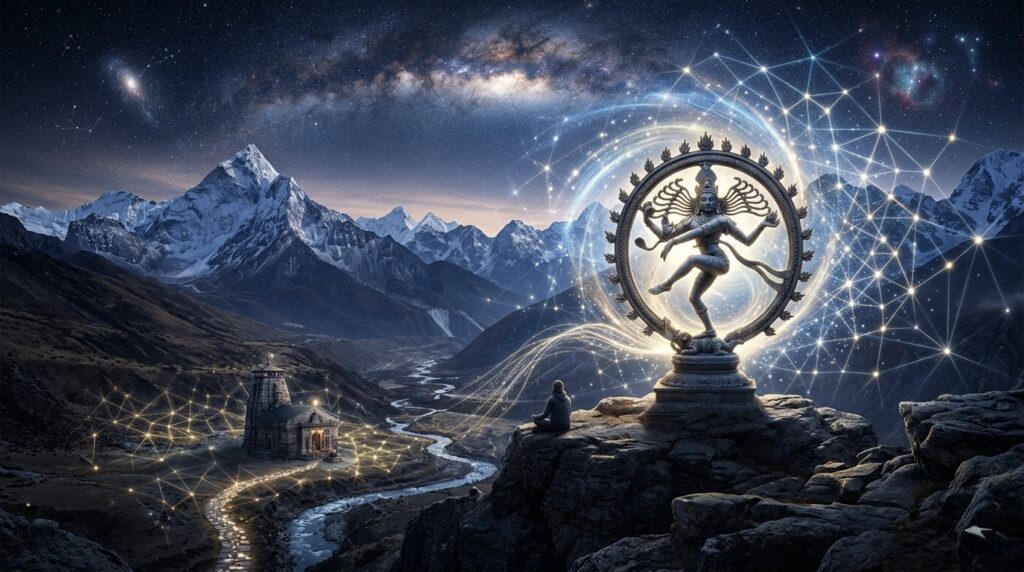
The specific finding that space may emerge from time — with temporality holding ontological priority — finds resonance across multiple Indian schools, though the convergence is not identical in each case.
In Vedāntic cosmology, the sequence of creation (sṛṣṭi-krama) places ākāśa as the first emergent element, arising from the vibratory intention of Brahman. But what precedes ākāśa? The spanda — the primal movement, the first differentiation within pure consciousness. And movement, by definition, is temporal before it is spatial. You cannot have location without extension; but you can have dynamism — pure becoming — without any fixed where.
Kashmir Śaivism makes this explicit in its doctrine of Spanda: the cosmos arises from the intrinsic pulsation (spanda) of Śiva’s universal consciousness. This pulsation is the primordial activity — what we might today call the most elementary quantum fluctuation — and spatiality emerges from it as a derivative mode. The Spanda Kārikās describe reality as vibratory consciousness that posits extension through its own self-delimiting movement. Temporality (or more precisely, dynamic potency) is the mother; spatiality is the daughter.
Even in Sāṃkhya, which does not privilege consciousness as ultimate, the three guṇas (sattva, rajas, tamas) in their eternal dynamism constitute an intrinsic temporality prior to any spatial configuration of Prakṛti. The Mahat (cosmic intelligence) and Ahaṃkāra (individuation) precipitate from this unlocated activity before ākāśa crystallises as the first gross element. Temporality is structurally prior to spatiality in the evolutionary sequence.
The Aurobindo Differential: Emergence Toward, Not Just From
Here is where Vedantum’s synthesis departs from both Śaṅkara’s Advaita and the standard physics narrative.
Most presentations of emergent spacetime treat the phenomenon as a reductive story: the apparent becomes explainable in terms of the underlying. Space reduces to entanglement. Time reduces to quantum information complexity. The direction of explanation runs downward — toward the simpler, the more fundamental.
Sri Aurobindo’s Integral Philosophy inverts the emphasis without denying the reduction. For Aurobindo, the universe is not merely consciousness in disguise — it is consciousness in process of self-disclosure. The emergence of space-time from deeper quantum relational structures is not just a story about ontological reduction; it is an episode in the involution and evolution of consciousness.
In the Aurobindonian cosmology, Brahman first involves itself — concentrating infinite consciousness into matter, appearing to become unconscious, spatial, inert.
The subsequent evolutionary movement is Brahman recovering itself through the vehicles of life, mind, and ultimately Supermind. Space-time, from this perspective, is not merely Māyā to be negated, nor merely entanglement geometry to be explained away. It is a functional mode through which consciousness creates the conditions for its own self-exploration.
The question this reframing raises for the physics is significant: if space emerges from quantum information, what is quantum information itself? The standard answer is epistemic — information is about correlations, measurement outcomes, observer-relative distinctions. But Penrose’s Gödelian argument presses harder: the capacity to recognize mathematical truth is not itself computational. The observer that “collapses” the quantum state is not merely a device registering classical outputs. There is, at the heart of the measurement problem, an irreducibly knowing element that current physics cannot locate within its own formalism.
This is precisely the gap that Vedānta steps into — not to provide a supernatural explanation, but to point out that the formalism has left the observer conspicuously undefined, and that the Indian philosophical tradition has the most sustained technical account of what observation, at its most fundamental, actually is.
The Synthesis: An Informational Brahman?
Let us be precise about what is being claimed and what is not.
Vedantum does not assert that quantum information theory proves Advaita. Equations do not establish liberation. The Upanishads are not physics papers, and physics papers are not Upanishads. The language, methodology, and epistemic goals of the two traditions are distinct.
What is being claimed is structural homology at the level of ontological architecture:
- Both traditions arrive at the conclusion that space and time are not fundamental.
- Both identify a substratum from which the phenomenal world is precipitated — one names it Brahman-Cit, the other names it quantum information.
- Both recognize that the observer is not external to what is observed — the measurement problem in physics and the Vedāntic teaching on the non-difference of Draṣṭā (seer) and Dṛśya (seen) are addressing the same structural peculiarity.
- Both leave the nature of consciousness itself as the unresolved remainder — the thing that neither the equations nor the mahāvākyas fully close around, because the knower cannot become its own complete object.
Some researchers already describe these efforts as hinting at an “informational operating system” underlying the cosmos — one in which the structure of reality emerges not from matter or energy alone, but from the flow and pattern of information itself. [5]
Vedānta would not dispute the description. It would only add: and information, at its root, is chitta — the knowing capacity of consciousness — which is not itself information in the technical sense, but the awareness within which information has its being.
Closing: The Question That Remains Open
The New Scientist article this essay responds to frames its finding as a challenge to Einstein’s special relativity — space and time, long treated as inseparable partners in the spacetime manifold, may be ontologically asymmetric. Time, or something more primitive than time, runs deeper.
From the Vedāntic side, this is not surprising. The Nasadīya Sūkta of the Rigveda — the Hymn of Creation, with which Vedantum opens — asks: nāsadāsīt no sadāsīt tadānīm — “Neither non-being nor being existed then.” Before space, before time, before the distinction between existence and non-existence: what was there?
Physics is now asking the same question through its own instruments. The answer, if there is one, will require both.
PS:
- This essay is part of Vedantum’s ongoing synthesis series — where the Upanishadic inquiry into consciousness meets the quantum physicist’s encounter with the observer, and both discover they were asking the same question.
- A note on methodology: The convergences identified here are structural and philosophical, not literal equivalences. Vedantum treats Indian philosophy and modern physics as two independent epistemic traditions that have approached the same domain — the nature of consciousness and reality — from different directions, using different methods. The synthesis claims resonance and shared orientation, not identity of content.
References:
- https://www.researchgate.net/publication/380668546_The_Emergence_of_Time_from_Quantum_Information_Dynamics
- https://journals.aps.org/prl/abstract/10.1103/pg4r-fy8n
- https://arxiv.org/abs/2506.06595
- https://www.nature.com/research-intelligence/nri-topic-summaries/emergence-of-spacetime-in-quantum-gravity-micro-458583
- https://thequantuminsider.com/2025/05/11/study-suggests-quantum-entanglement-may-rewrite-the-rules-of-gravity/
Other References:
Leave a Reply