What quantum mechanics uncovered — and could not explain
In 1801, Thomas Young darkened a room, positioned a card with two narrow slits cut into it, and allowed a beam of light to pass through. What appeared on the screen behind it was not two bands of light — the result a common-sense particle theory would predict. What appeared was a series of alternating bright and dark fringes. An interference pattern. The kind of pattern that only waves produce when they overlap, reinforce, and cancel each other.
Young had not set out to ask a philosophical question. He was attempting to settle an empirical one — whether light was a particle, as Newton had maintained, or a wave, as Huygens had argued. The interference pattern seemed to settle it decisively in favour of waves.
It settled nothing. It opened something.
The Hidden Assumption
Before examining what the experiment revealed, it is worth examining what neither Newton nor Huygens — nor the scientific tradition they both inhabited — thought to question.
The assumption was not stated because it did not need to be. It was the air the framework breathed. Reality is objective — it exists independently of whether anyone is looking at it. Observation is passive — the act of measurement reveals what is already there without participating in what is there. The experimenter stands outside the system, a neutral recorder of facts that would be the same whether recorded or not.
This was not a conclusion that science had reached. It was the unexamined foundation on which science was built. And for two centuries, everything constructed on that foundation — classical mechanics, thermodynamics, electromagnetism — appeared to confirm it. Not because the assumption was tested. Because nothing in the classical domain forced it to be.
Young’s experiment did not immediately disturb this foundation. The observer was still outside. The light was still behaving according to its nature, wave-like as it turned out, regardless of who was watching. The assumption held.
For another century, it held.
The First Rupture
Young’s interference result established that light propagates as a wave. The mathematics of wave mechanics described its behaviour with precision. The case appeared closed.
Then, in 1905, Albert Einstein published his analysis of the photoelectric effect — the phenomenon by which light striking a metal surface ejects electrons. The wave theory predicted that increasing the intensity of light would increase the energy of ejected electrons. The experiment showed something different: what determined the energy of the ejected electrons was not the intensity of the light but its frequency. And below a certain frequency threshold, no electrons were ejected at all, regardless of intensity.
This behaviour could not be explained by a wave. It required discrete packets of energy — what Einstein called quanta, what we now call photons. Light, it appeared, was after all composed of particles.
Both conclusions were now supported by rigorous experiment. Both contradicted each other. Light produced interference patterns that only waves produce. Light ejected electrons in a manner that only particles could explain. The response of the scientific community was not, initially, to question the framework. It was to assume the contradiction was temporary — that a more complete theory would eventually resolve it.
The more complete theory arrived. It did not resolve the contradiction. It formalised it.
The Experiment That Refuses Interpretation
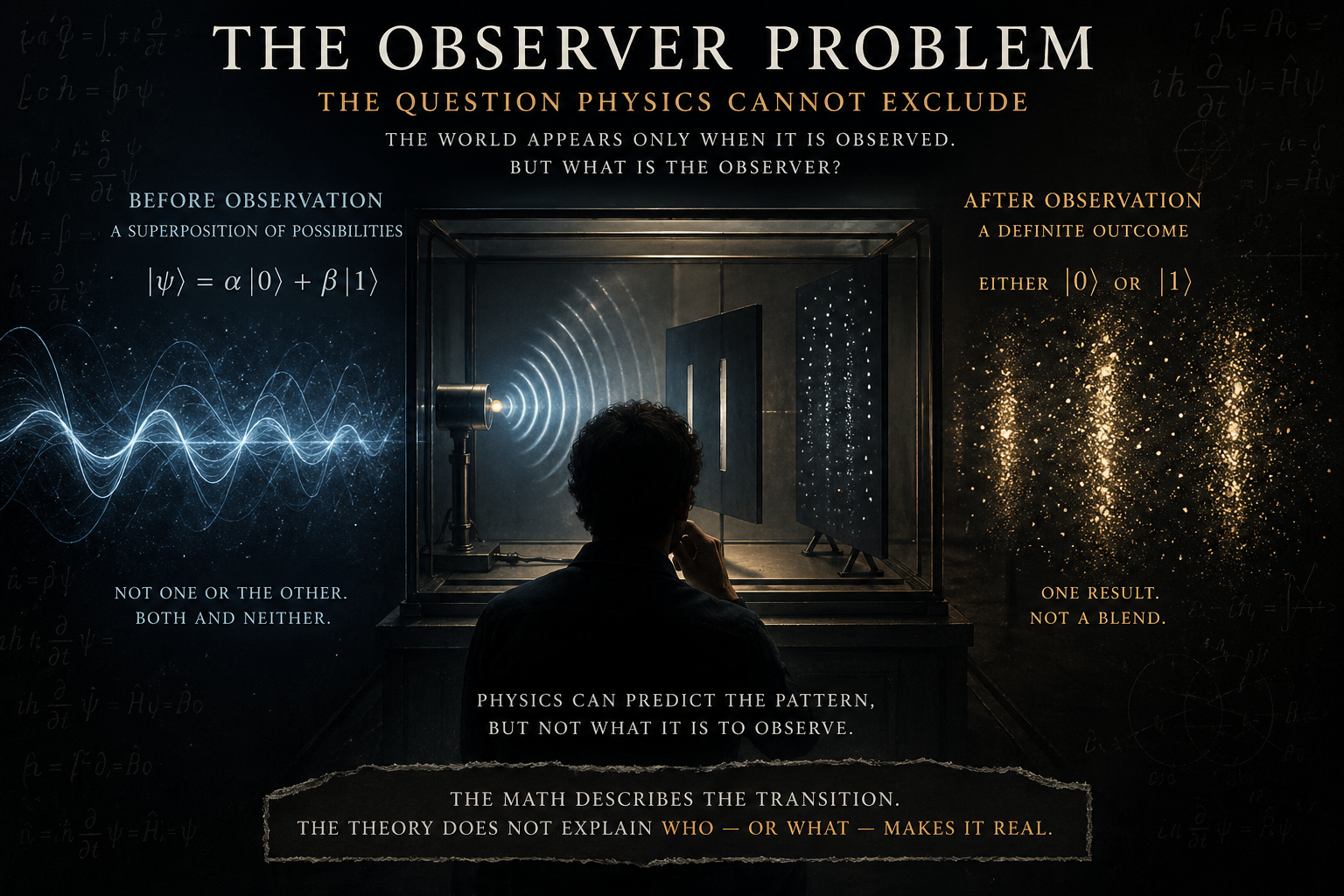
The quantum double-slit experiment with electrons is, arguably, the most consequential single experiment in the history of science — not for what it established, but for what it refused to allow.
The setup is a controlled extension of Young’s original. Electrons are fired at a barrier with two slits, one at a time. No classical wave present — single particles, fired singly, each detected when it strikes the screen behind the barrier. If electrons are particles, the result should be two bands, each corresponding to a slit. If electrons are waves, an interference pattern should build across many detections.
Across many detections, an interference pattern emerges.
A single electron, fired alone, produces a result that is consistent with interference across both slits — as though the particle existed as an extended probability distribution across the entire barrier until the moment of detection, at which point it arrived as a localised event at a specific point on the screen.
This is already uncomfortable. What follows is more so.
When a detector is placed at the slits — not a human observer, but any physical apparatus capable of registering which slit the electron passed through, any arrangement by which which-path information becomes available in the system — the interference pattern collapses. The electrons begin arriving in two bands. Particle behaviour returns.
The critical precision: it is not the presence of a conscious observer that produces this effect. It is the availability of which-path information — the physical entanglement of the electron’s path with any part of the environment capable of registering it. When no which-path information exists anywhere in the system, interference occurs. When which-path information exists, it does not. The calculation works. What it describes, ontologically, remains unresolved.
The Conflict That Would Not Resolve
The disagreement between Niels Bohr and Albert Einstein was not a dispute between a careful thinker and a careless one. It was a collision between two deeply held and internally coherent philosophical positions, sustained over three decades, conducted at the highest level of scientific rigour available to either man.
Einstein’s position was realism. A complete physical theory must describe a reality that is definite, observer-independent, and locally determined — meaning that no influence can propagate between distant parts of a system faster than light. If the theory did not provide this description, the theory was incomplete. The electron must have a definite position before measurement. If quantum mechanics could not tell us what that position was, the problem was with quantum mechanics, not with the electron.
Bohr’s position is frequently misrepresented. He did not claim that consciousness collapses the wave function. He made a more careful and more epistemically disciplined claim: that physics describes phenomena as they appear under specific experimental conditions, not an independent reality that underlies those conditions. The question of what the electron is doing between measurements — where it is, what state it is in, what it is — may not be a question that physics, by its own methodological commitments, is designed to answer. This was not defeatism. It was a precise statement about the scope of a formal discipline.
Einstein found this intolerable. The two men argued at Solvay in 1927, at Solvay again in 1930, and in print through the 1930s and 1940s. Einstein proposed thought experiments intended to demonstrate that quantum mechanics was incomplete. Bohr answered each one. Neither convinced the other.
The experimental resolution came after both men were dead. John Bell’s 1964 theorem demonstrated that if Einstein’s locally realistic hidden variable theory were correct, certain measurable correlations between distant particles would have to fall within specific limits. In 1982, Alain Aspect and his collaborators measured those correlations. They exceeded Bell’s limits. Subsequent experiments, closing successive loopholes, have consistently confirmed the result. No locally realistic hidden variable theory can reproduce the predictions of quantum mechanics. Einstein’s realism, in its classical form, does not survive the data.
What the Experiments Actually Force Us to Accept
It is worth being precise about what the experimental record establishes — and what it does not.
Three things the data consistently shows, stated without overreach.
First: the violation of local realism. Correlations exist between spatially separated particles that cannot be explained by any locally causal model — no account invoking influences constrained by both locality and realism can reproduce them. This is not an interpretation. It is what Bell’s theorem requires and what experiment confirms. What these correlations mean about the structure of reality remains a matter of genuine dispute.
Second: the standard formalism does not assign a definite state to a quantum system prior to measurement. This is a statement about the formalism — about what the mathematical framework provides — not a claim about all possible interpretations of quantum mechanics, some of which do attempt to assign definite pre-measurement states through different mechanisms. The standard framework does not. This is not an accidental omission. It is a structural feature of how the theory is built.
Third, and most important for what follows: the formalism works. Its predictive precision is unmatched in the history of science. And the question of what it is describing — what is actually happening at the level of physical reality — is genuinely, seriously, unresolved. This is not a temporary state awaiting resolution by further experiment. It is a structural feature of the current situation that has persisted through a century of increasingly precise measurement.
We know exactly how to calculate this. We do not know what it means.
Three Ways to Survive the Data
The interpretations of quantum mechanics are not competing explanations of what is happening. They are attempts to preserve coherence under a set of mutually incompatible constraints — each solving one tension by accepting another, none dissolving the problem entirely.
The Copenhagen interpretation accepts an epistemic limit as its foundation. The wave function is a calculational tool for predicting measurement outcomes. Physics describes what is observed under experimental conditions. The question of what exists between measurements is not a question the interpretation attempts to answer. This is not evasion. It is a disciplined refusal to claim more than the formalism supports. Its cost is that it provides no picture of reality — only a procedure for prediction.
The Many-Worlds interpretation avoids wave function collapse entirely. Every measurement outcome occurs — in branching, non-communicating versions of reality. The apparent collapse is an artifact of the observer’s perspective from within one branch. The cost is ontological: an uncountably vast proliferation of entire universes generated by every quantum event, a metaphysical inflation that is rarely examined with the seriousness it deserves. The mathematics is clean. The implied ontology is staggering.
Objective collapse theories — of which Roger Penrose’s Orchestrated Objective Reduction is the most rigorously developed — propose that wave function collapse is a real physical process, not merely an epistemic updating. For Penrose, collapse is tied to quantum gravity, to instabilities in spacetime geometry at the Planck scale. Consciousness is not the cause of collapse in this framework. But in Penrose’s further argument — that human mathematical understanding cannot be accounted for by any computational mechanism, drawing on Gödel’s incompleteness theorems — consciousness emerges as a phenomenon that such a framework may eventually need to account for. He does not claim to have resolved this. The argument raises a question that the physics of collapse has not yet addressed.
Each interpretation survives the data. None of them dissolves the problem. The choice between them is currently underdetermined by experiment — a fact that is itself significant.
The Observer as a Category Problem
The standard response to the measurement problem has been to refine the physical account of observation — to describe it more precisely in terms of decoherence, entanglement with the environment, the thermodynamic irreversibility of measurement. These refinements are genuine achievements. They have clarified what was previously vague and resolved certain apparent paradoxes.
They have not resolved the observer problem. In certain respects, they have sharpened it.
Decoherence explains why quantum superpositions become effectively classical at macroscopic scales — why we do not observe cats that are simultaneously alive and dead. It does not explain why any particular outcome is experienced by the observer rather than another. It accounts for the suppression of interference, not the selection of a single realised outcome. The problem of the definite experienced outcome — the fact that you observe the electron at a specific location, not smeared across a probability distribution — remains.
What this persistent resistance to physical resolution may suggest — stated carefully, as a possibility rather than a conclusion — is that the observer, in the sense that quantum mechanics requires but cannot define, may not be the kind of entity that can be represented within a physical theory. It is presupposed by the formalism yet cannot be fully contained within it. Physics proceeds by representing systems in mathematical formalisms, extracting predictions, and comparing them with measurement. The observer appears in this procedure as both the one who formulates predictions and the locus at which measurements are registered. Every attempt to bring it fully inside — to treat the observer as just another physical system — generates the measurement problem in a new form.
This is not a gap that improved measurement alone can resolve. It may indicate something more fundamental: that the question of what observation is belongs, at least in part, to a domain that physical theory, by its own methodological structure, is not designed to enter.
The discipline most dependent on the act of observation has, after a century of extraordinary precision, produced no satisfactory account of the observer. That is a remarkable situation. It deserves to be held as such — not explained away, not deferred to future physics, but examined directly for what it may be telling us about the limits of a particular kind of inquiry.
A Question Approached From the Other Direction
Physics arrived at the observer problem through experiment — through two centuries of increasingly precise measurement producing increasingly uncomfortable results, until the discomfort could no longer be managed within the existing framework and had to be acknowledged as structural.
There is a different tradition that did not arrive at this question. It began there.
Not the observer as a measurement apparatus. Not the observer as a variable in a physical formalism. But the observing awareness itself — its nature, its relationship to what it observes, whether the apparent distinction between the one who observes and the thing observed is a fundamental feature of reality or a feature of a particular and perhaps limited mode of experience. These were not preliminary questions in this tradition, waiting to be replaced by more precise ones. They were the primary questions — the ones around which an entire methodology of inquiry was built over several millennia.
Whether that tradition articulates a position that can speak precisely to what physics has uncovered — not by borrowing physics’ language, not by claiming physics as confirmation, but by engaging the same problem from a different direction with its own rigour intact — is not a question that can be settled by assertion. It requires the same discipline that physics demands: careful argument, precise language, and a willingness to follow the inquiry where it raises questions rather than where it is expected to arrive.
That examination begins in the next essay.
The observer problem did not begin with quantum mechanics. Quantum mechanics is where it became impossible to ignore.
Vedantum — Deciphering Consciousness & the Nature of Reality
Leave a Reply