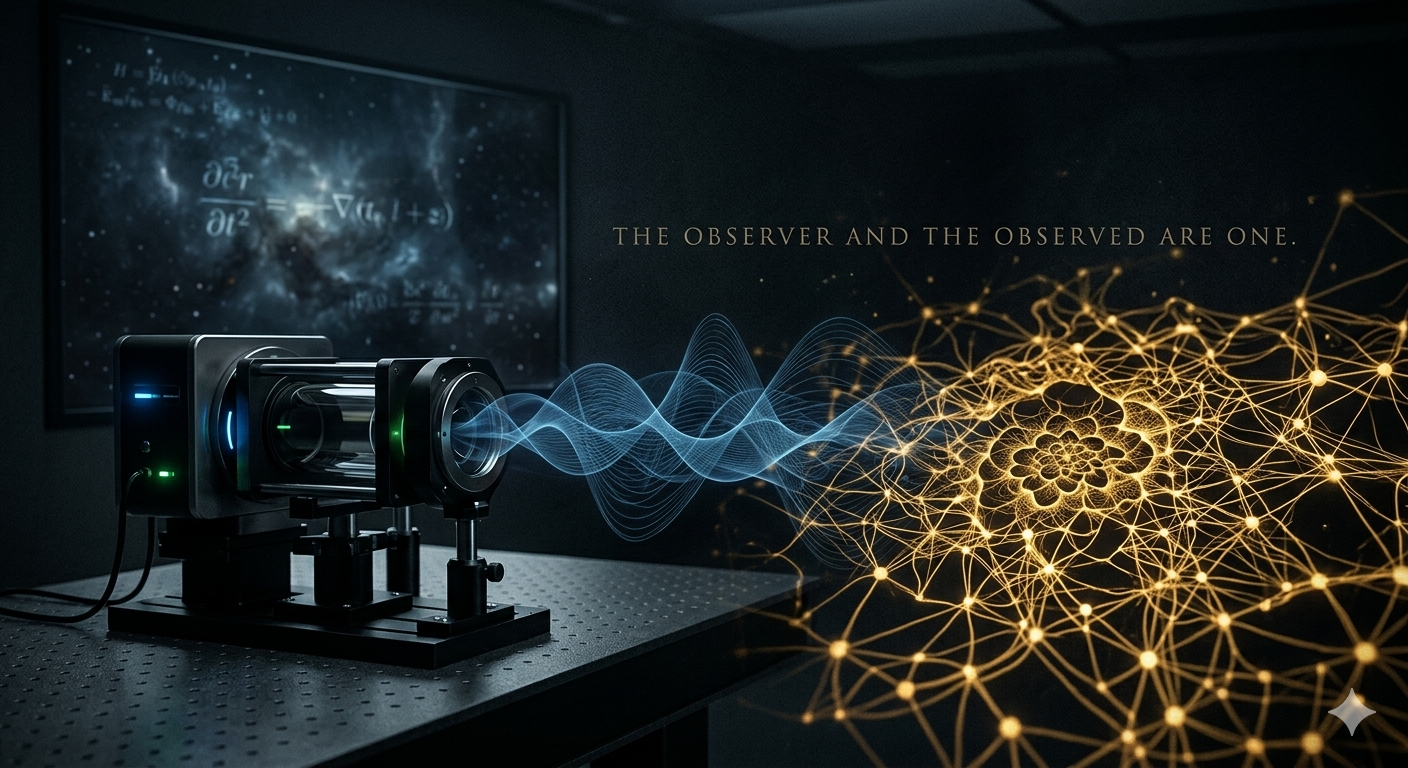
The structure of experience and the question physics left open
The problem is no longer how the world is observed. The problem is what is doing the observing.
Essay 1 arrived at a precise boundary. Quantum mechanics — the most empirically successful theory in the history of science — cannot be formulated without reference to the observer, and cannot account for what the observer is. The observer is presupposed by the theory in a way the theory itself does not capture. Every attempt to bring it fully inside the formalism — to treat it as just another physical system subject to the same laws — regenerates the measurement problem in a new form.
Nothing in the formalism of quantum mechanics requires consciousness; the difficulty arises at the level of interpretation, where the role of the observer cannot be cleanly eliminated. Approaches such as decoherence relocate the problem but do not remove the question of definite outcomes.
Physics has reached a boundary where the observer cannot be excluded. It has not answered the more fundamental question: what is it that observes?
This is where the present inquiry begins. The question is not rhetorical. It is the next logical step — forced by the structure of what the physics actually shows. If the act of observation cannot be removed from the description of reality, then an account of reality that cannot explain the observer is, by its own terms, incomplete. And the question it generates cannot be answered by the same methodology that produced it.
Why Physics Cannot Answer This
The methods of physics are third-person methods. They describe systems from outside — in mathematical formalisms, through measurable quantities, by means of experiments that are in principle repeatable and communicable to any observer in any location. This is the source of physics’ extraordinary power — and its structural constraint.
Every scientific description of consciousness is a third-person description of something that is, in its primary form, a first-person phenomenon. Neuroscience can identify which neural circuits are active during a particular experience, map the correlates of attention, memory, and perception with increasing precision — and still not capture what it is like to have the experience. The map is always drawn from outside. The territory it attempts to describe is always encountered from within.
David Chalmers formalised this as the hard problem of consciousness — the question of why any physical process is accompanied by subjective experience at all, rather than occurring without any accompanying inner dimension. The hard problem has not been solved. More precisely: it has not been clear what a solution would even look like, because subjective experience is not a third-person phenomenon, and every proposed solution has been a third-person account. The explanatory gap is not a gap in knowledge that more data will close. It is a gap in category.
Physics, which arrived at the observer problem through experiment, finds itself at the same impasse by a different route. To make progress, the direction of inquiry must change — from the attempt to describe the observer from outside, to the examination of what observation is from the only place where it is directly available.
From within experience itself.
The Structure of Experience
Experience is not a uniform medium. It has structure — distinguishable features present in every act of experiencing, regardless of what is being experienced.
Experience presents itself with a minimal but irreducible structure: it appears as content, it is directed toward that content, and it is given within an awareness that is not itself part of what appears.
Content is variable — sensations, perceptions, thoughts, memories, emotions, appearing and disappearing continuously. Directedness is constant — experience is never passive, it always reaches toward its object, perception is perception of something, thought is thought about something. And the awareness in which both appear is neither content nor direction but their condition — not another object in the field, but the field in which objects appear.
These three features are not a theory about experience. They are a description of its structure, present in any moment of careful attending to what is actually given.
The Instability of the Observer
The question now becomes more precise. Is there, within this structure, a stable observer — a continuous, locatable self that is doing the experiencing?
The intuition that such a self exists is immediate and persistent. Experience feels owned. Thoughts feel like my thoughts. The sense of being a continuous subject — the same one who woke this morning, who remembers yesterday, who anticipates tomorrow — is one of the most consistent features of ordinary experience.
Examined carefully, this sense of continuity does not hold up in the way it initially appears to.
Thoughts appear without prior indication of their arrival. The next thought cannot be predicted or directly commanded. If a stable, continuous observer were fully present and operating, this would be unexpected — yet it is the ordinary structure of mental life, not an exception to it.
Attention moves without always being explicitly directed — toward a sound, away from a task, into an associative chain that was not deliberately initiated. This is not an abstract observation. It can be verified immediately, in the movement of one’s own thought as one reads this sentence. The movements of attention are not random, but neither are they fully under the command of whatever claims to be commanding them.
Memory, which seems to supply the thread of continuity, is not continuous access to a stored past. It is reconstruction — a present-moment activity that assembles an account of what was. The experienced past is not directly present. It is represented, and the representation shifts across time, across emotional states, across contexts. The sense of being the same person who had that experience is constructed in the present, not retrieved from an unbroken record.
Identity itself is not fixed. The sense of self present in focused work is structurally different from the one present in grief, in physical pain, in states of complete absorption, in the border between waking and sleep. The boundaries of what feels inside the self and what feels outside are not stable. They expand and contract with attention, with circumstance, with the degree to which experience is reflectively observed or simply lived.
The structure of experience does not support a stable, continuously accessible observer that can be located as a fixed object within experience. The self that is assumed to be doing the observing cannot be found when looked for directly. Every attempt to locate the observer as an object produces only more content — more thoughts, more sensations, more representations — but not the observer itself.
The observer is not a thing that appears within experience. It is that in which experience appears.
The Boundary
The investigation has reached a second boundary — different in kind from the one physics reached, but structurally related.
Physics found that the observer cannot be excluded from the description of reality and cannot be described within it. The examination of experience finds that the observer cannot be located as an object within experience and cannot be separated from it. In both cases the observer is simultaneously necessary and unaccountable by the methods available. In both cases the attempt to treat the observer as just another item in the inventory — just another physical system, just another object of experience — fails in a characteristic way.
The observer withdraws. It is always the one looking, never what is looked at.
The ‘observer’ in physics is a formal element within a theoretical framework; the awareness described here is not a component of a model but the condition for any model to appear. The convergence is structural, not identificatory.
This convergence is not coincidental. It is what happens when two different methodologies — one moving from the outside in, one examining the inside directly — reach the same structural feature from opposite directions. Physics reached it through measurement. Phenomenological analysis reached it through the examination of experience. Neither has the resources, within its standard operating boundaries, to go further.
This is not a failure of either discipline. It is a signal that the question belongs to a domain that requires a different kind of inquiry — one that takes the observer not as a problem to be solved from outside, but as the primary subject of direct investigation.
A Different Inquiry Existed
The structure of experience described in this essay — the distinction between the content of awareness and the awareness in which content appears, the instability of the constructed self, the impossibility of locating the observer as an object — was not first identified by twentieth-century phenomenology. It was investigated, with systematic precision, within traditions of inquiry that took the nature of the observer as their foundational question long before the vocabulary of modern philosophy existed.
One such tradition pursued this line of inquiry with unusual rigour and depth — developing a methodology of first-person investigation that is not reducible to introspection in the casual sense, and arriving at a position regarding the nature of awareness that is directly relevant to the questions this series is examining. What is here described as the field of experience — the awareness in which all content appears, which is not itself an object — corresponds to a category this tradition analysed in considerable detail, and about which it reached conclusions that the dominant scientific and philosophical frameworks have not yet seriously engaged.
That tradition, and the precise position it reached, is where the next essay begins.
The question is no longer whether experience can be explained in terms of physical processes. The question is whether any account of physical processes is complete without first accounting for experience.
Vedantum — Deciphering Consciousness & Nature of Reality
Leave a Reply