Tag: Advaita vedanta
-
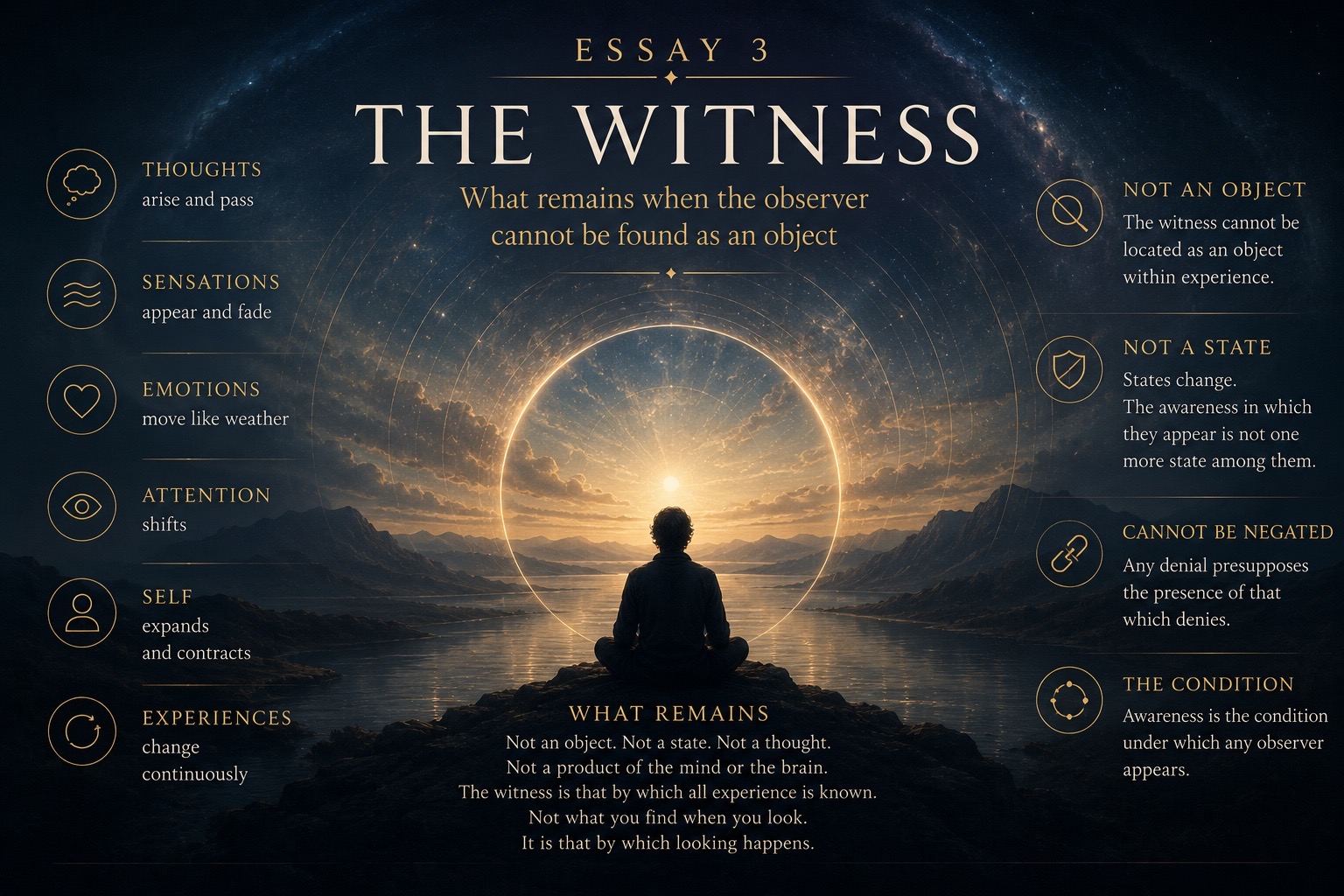
ESSAY 3 — THE WITNESS
What remains when the observer cannot be found as an object Something has gone unnoticed in the course of the last two essays. Not a concept. Not an argument. Something closer to home than either. Essay 1 tracked the observer problem through a century of physics — from Young’s darkened room to Bell’s theorem —…
-
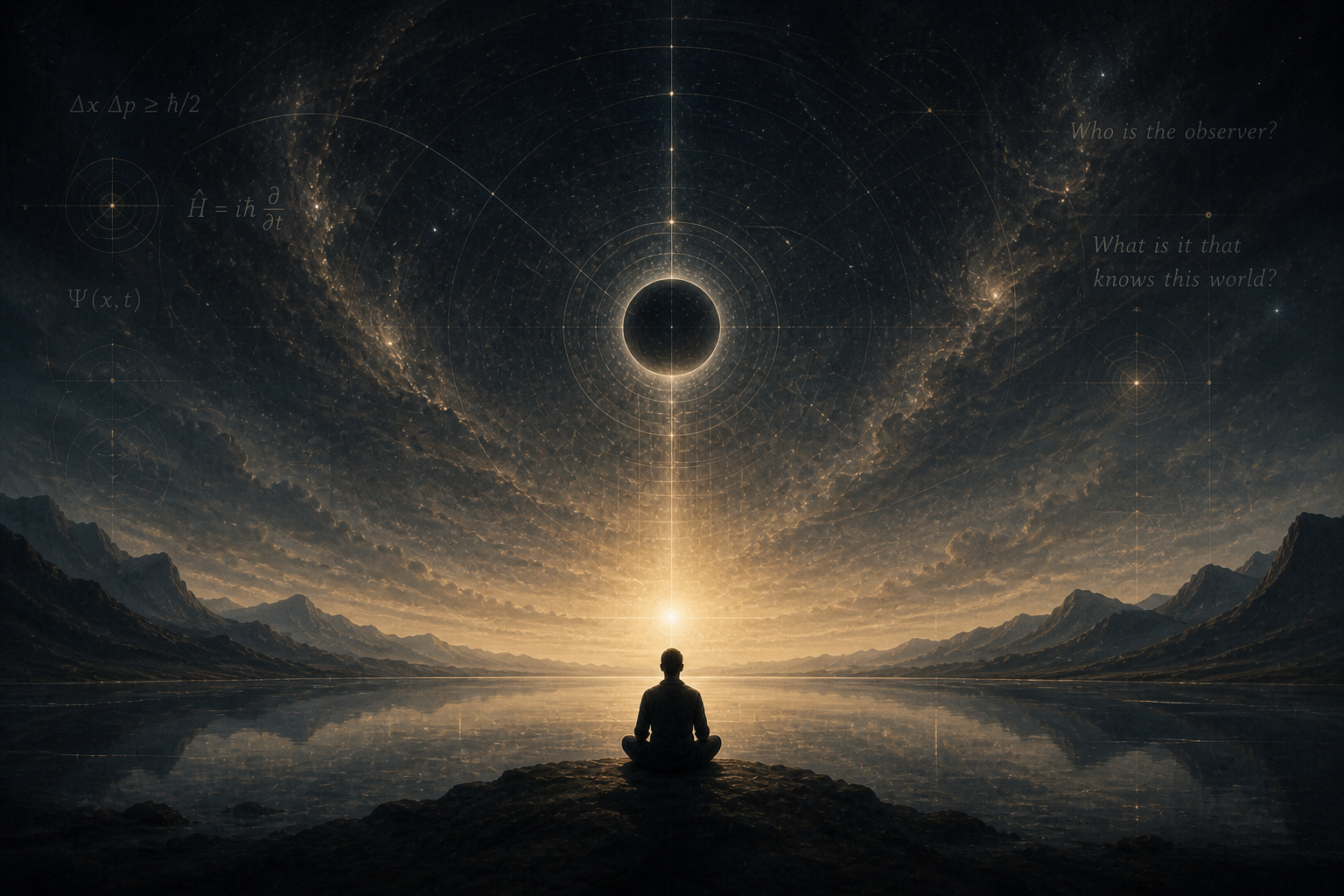
Seven Notes on The Observer
Argument 1: The Question Physics Cannot Answer From Inside Physics, Why? Every experiment in quantum mechanics requires a specification of measurement — which introduces the question of the observer. Not metaphorically. Not as a poetic flourish. The mathematical formalism of quantum mechanics — the Schrödinger equation, the Born rule, the measurement problem — cannot be…
-
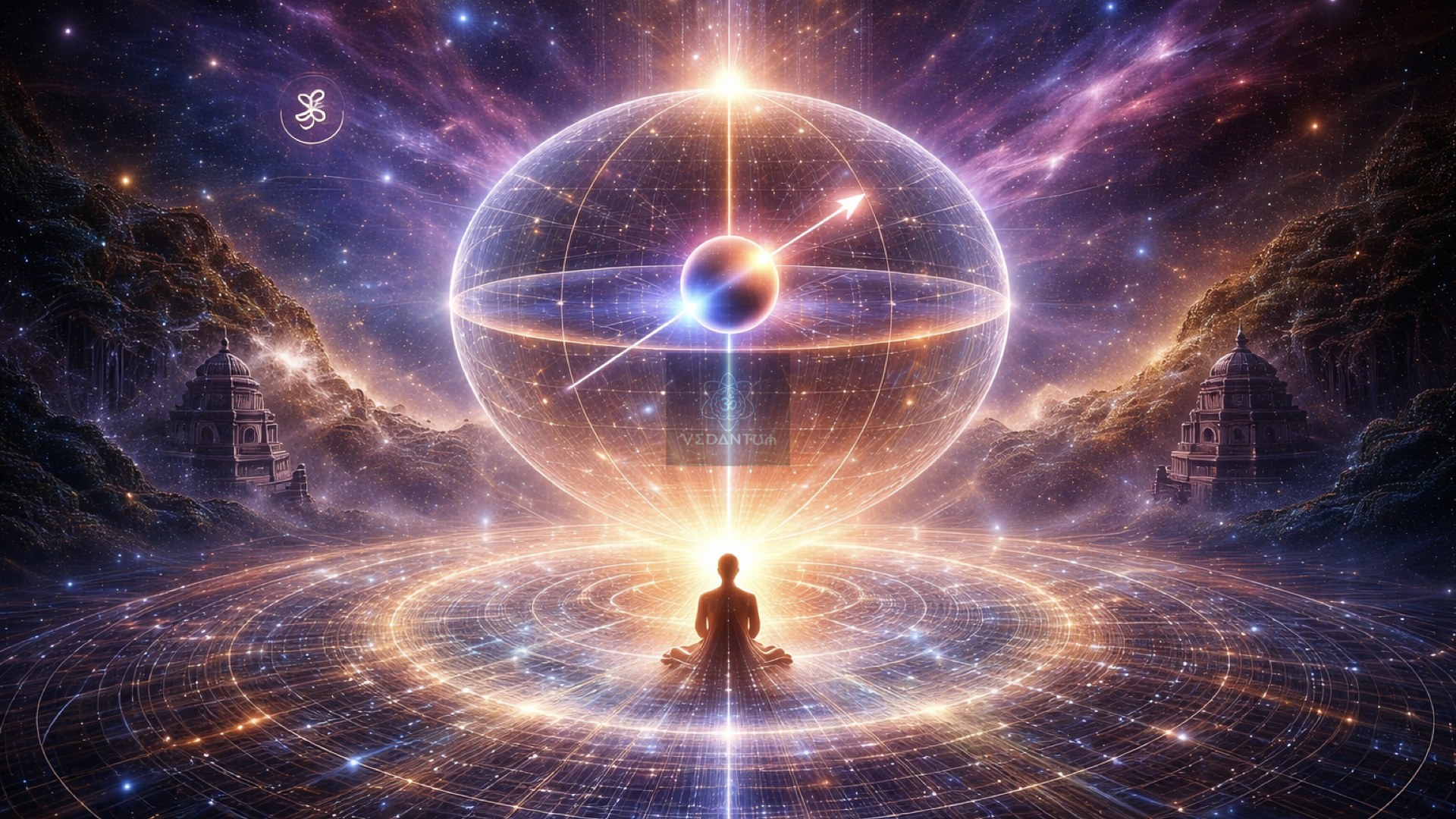
Advaita Vedanta and QIH Cosmos: Toward a Non-Dual Nature of Reality-02
Part -2: Maya, Pratibimbavada, and the Non-Dual Nature of Appearance In previous article we discussed that physics does not merely describe the world; it begins to reveal the process by which the world appears. If one follows this line of inquiry further, the transition from physics into philosophy is no longer abrupt but almost inevitable.…
-
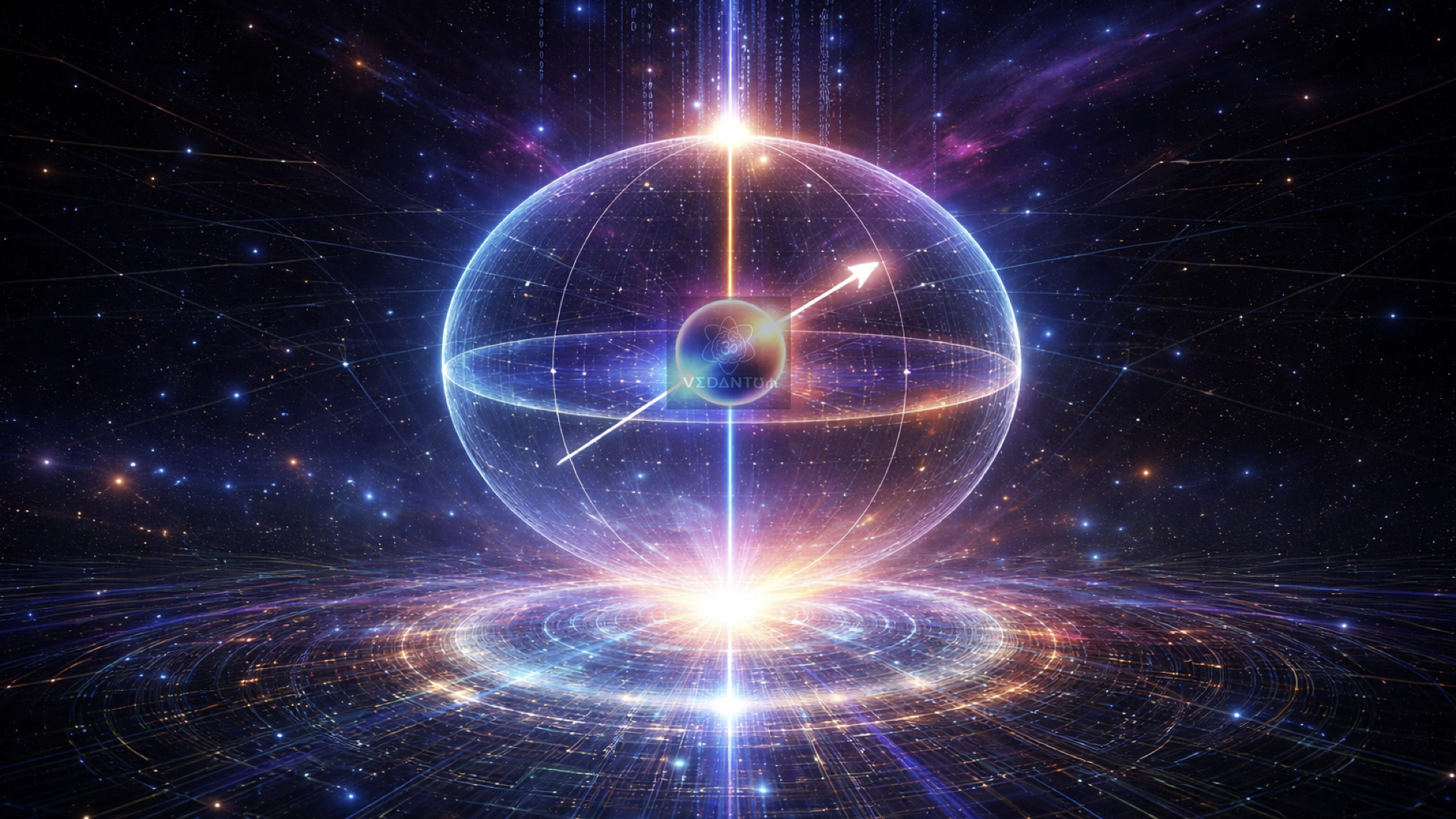
Advaita Vedanta and QIH Cosmos: Toward a Non-Dual Nature of Reality-01
Part 1: Quantum Information Holography and the Emergence of Spacetime Reality, when approached through the lens of modern quantum theory, no longer begins with particles or objects, but with structured information encoded in mathematical form. At its foundation lies the qubit, a two-state system that does not exist as a fixed entity but as a…
-
Vedanta (Upanishad) and Quantum Physics-2
There is no meaning to the objective existence of an electron at some point is space, for example at one of the two holes, independent of actual observation. The electron seems to spring into existence as a real object only when we observe it. – The Cosmic Code, by Heinz Pagels (President of New York…
-
Vedanta (Upanishad) and Quantum Physics-1
One among the biggest problem of Physics today… Our body is made of atoms. In turn, these atoms are made of particles called electrons and quarks. Here’s the weird bit — inherently, these electrons and quarks have no mass. But when they interact with the Higgs field, they get mass. The Higgs field, it creates…