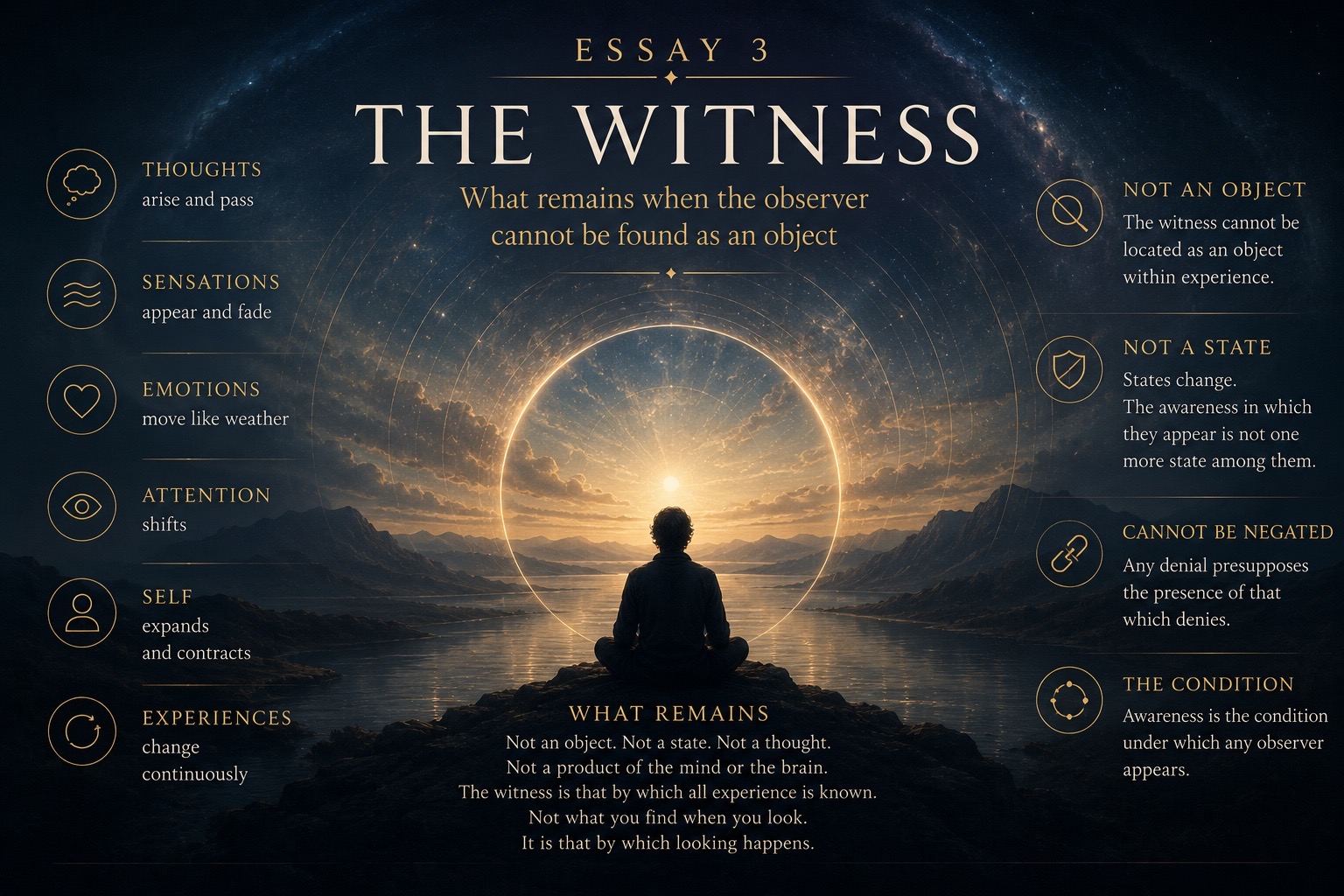
What remains when the observer cannot be found as an object
Something has gone unnoticed in the course of the last two essays. Not a concept. Not an argument. Something closer to home than either.
Essay 1 tracked the observer problem through a century of physics — from Young’s darkened room to Bell’s theorem — and arrived at a precise conclusion: the observer is presupposed by the formalism of quantum mechanics yet cannot be fully contained within it.
Essay 2 turned the inquiry inward, examining the structure of experience directly, and arrived at a parallel conclusion: the observer cannot be located as an object within experience and cannot be separated from it. In both cases the same structural feature appeared. The observer withdraws. It is always the one looking, never what is looked at.
But something was present through every failed attempt to find it.
The searching itself was witnessed — not as a separate object standing apart from the search, but as the condition under which the search appeared at all. Every thought examined, every sensation noticed, every moment of attention turned back on itself — all of it appeared within something that was not itself the content being examined. That something did not announce itself. It did not arrive when looked for. It was simply there — as it is now, as you read this sentence and notice that you are reading it.
That is where this essay begins.
A Note on Method
Before proceeding, one clarification is necessary — not as an interruption but as an orientation.
The first two essays operated within established methodologies. Physics proceeds by third-person description — mathematical formalisms, measurable quantities, repeatable experiments. Phenomenological analysis proceeds by examining the structure of experience as it presents itself, prior to theoretical interpretation. Both methodologies reached a boundary. Not a failure — a limit. The kind of limit that signals the question belongs somewhere the method cannot fully enter.
What follows is not a departure from rigour. It is a change of instrument.
The investigation now turns to what is irreducibly present in every moment of experience — not as an object within experience, but as its condition. This requires a form of inquiry that is neither third-person description nor casual introspection. It is the careful, disciplined examination of what cannot be removed from experience regardless of what experience contains. The standard of precision remains the same. What changes is the direction of attention.
This is not a move toward belief. It is the next step the argument itself demands.

What Remained
Return for a moment to where Essay 2 ended.
Every attempt to locate the observer as a fixed object within experience produced only more content — more thoughts arising, more sensations registering, more representations assembling themselves into a temporary sense of self. The observer was never found as a thing. But the search did not occur in darkness. Each attempt was witnessed. Each arising thought was noticed. Each moment of not-finding was itself somehow known.
The searching was witnessed — not as a separate object, but as the condition under which the search appeared.
This is not a subtle philosophical manoeuvre. It is the most ordinary fact of experience, so close and so constant that it is almost always overlooked. Right now, as these words are read, there is awareness of reading. That awareness is not the words. It is not the comprehension assembling itself. It is not the slight movement of attention as one sentence gives way to the next. It is what all of that appears within.
It is present now, as these words are read — and as attention moves from one sentence to the next. It is present in every experience that can be examined directly.
The question is what it is.
What Is Always Present
Across the full range of waking experience, one feature persists regardless of what the content of experience happens to be.
Experiences change continuously. Thoughts arise and dissolve. Sensations appear and pass. Emotions move through like weather — sometimes intense, sometimes barely perceptible, never permanent. Attention shifts without always being explicitly directed. The sense of self expands and contracts with circumstance. None of this is fixed.
And yet all of it is registered. Every change, every arising, every passing — known. Not known by another thought that happened to observe it. Known within something that functions as the condition under which variation is registered.
This is not a metaphysical claim. It is an operational observation — limited, deliberately, to what waking experience directly warrants. Whether this continues across states where direct access is unavailable — dreamless sleep, deep absorption, the dissolution of ordinary self-boundaries — cannot be established from retrospective report alone. Memory of having been aware is not the same as direct access to awareness in that state. That question is held open.
What can be said, within the scope of what is directly accessible: awareness functions as the condition under which variation is registered. It is not another variation. It is what variation appears within.
The Witness Is Not a State
Every identifiable state of experience changes.
The quality of awareness present in focused intellectual work is different from the quality present in grief. The sense of self in a moment of physical pain has different boundaries from the sense of self in a moment of complete absorption in music or mathematics. Waking experience has a texture that dreaming does not. The alert, outward-facing attention of active engagement feels different from the quiet, inward quality of reflection.
States change. They vary with circumstance, with health, with time of day, with whether one has slept. This is not a problem. It is simply what states are.
But the awareness in which these states appear does not appear, within observation, to vary with them. It is not another state alongside waking, dreaming, grief, or clarity. It is not produced by any particular state and is not observed to disappear with any particular state. It is — to be precise about what is being claimed here — the condition within which states appear and within which their differences are registered.
This is an observational statement, not an ontological one. It does not claim that awareness is eternal, or unchanging in some absolute sense, or independent of the body and brain. Those are further questions. What is being noted here is simpler and more immediate: within the scope of observation, awareness does not appear to be one more variable among the variables it registers.
That is worth sitting with before moving further.
The One Thing That Cannot Be Set Aside
The inquiry has now reached a point where a precise logical observation becomes necessary.
Every object of investigation can, in principle, be set aside. A thought can be observed arising and allowed to pass. A sensation can be noticed and released. Even the sense of being a continuous self — as Essay 2 demonstrated — can be examined, found to be constructed, and seen through without destroying the capacity to function. These are objects of experience. They can be held at a distance by the act of observation.
Awareness cannot be set aside in this way.
Any attempt to deny the presence of awareness presupposes the presence of what is doing the denying. Any attempt to step outside awareness in order to examine it as an object requires awareness to perform the stepping. Any argument constructed to demonstrate that awareness does not exist is itself an act of awareness — and therefore cannot be coherently denied within the act of denial.
This is not a trick of language. It is not a definition constructed to be unfalsifiable. It is a functional necessity — the one feature of the inquiry that cannot be excluded from the act of inquiry itself. Every other element of experience can be made an object of investigation. This one resists objectification not because it is hidden or subtle but because it is the condition under which objectification occurs.
The eye cannot see itself seeing. Not because it lacks sufficient power, but because seeing is what it is — not another thing to be seen.
What This Forces
The investigation has now established several things in sequence.
Awareness is present as the condition under which variation is registered. It does not appear, within observation, to vary with the states it registers. It cannot be located as an object within experience. And it cannot be coherently denied within the act of denial.
What follows from this — carefully, without overreaching — is not a conclusion but a forced reconsideration.
If awareness cannot be treated as just another object within experience, then it cannot be treated as a property of an already-defined observer. The ordinary assumption runs: there is a self, and that self has awareness, the way a person has a name or a body has a temperature. But this assumption has not survived examination. The self, as Essay 2 showed, is constructed — assembled from memory, habit, and narrative, unstable at its boundaries, unable to be located as a fixed object.
The relation may need to be reversed.
It may be that awareness is not something the observer has. It may be that the observer — the constructed, located, narrative self — is something that appears within awareness. Not the other way around. Awareness as the condition. The observer as an appearance within it.
Two possibilities sit here, both requiring examination.
- Either awareness is a localised property of individual biological experience that merely appears invariant from the inside — a sophisticated feature of complex nervous systems, no more.
- Or its nature is something whose boundaries are less fixed than ordinary experience suggests. Both possibilities deserve serious examination. Neither is assumed.
That the structure identified here was examined with unusual rigour in older traditions of inquiry will become relevant as the series develops.
Leave a Reply