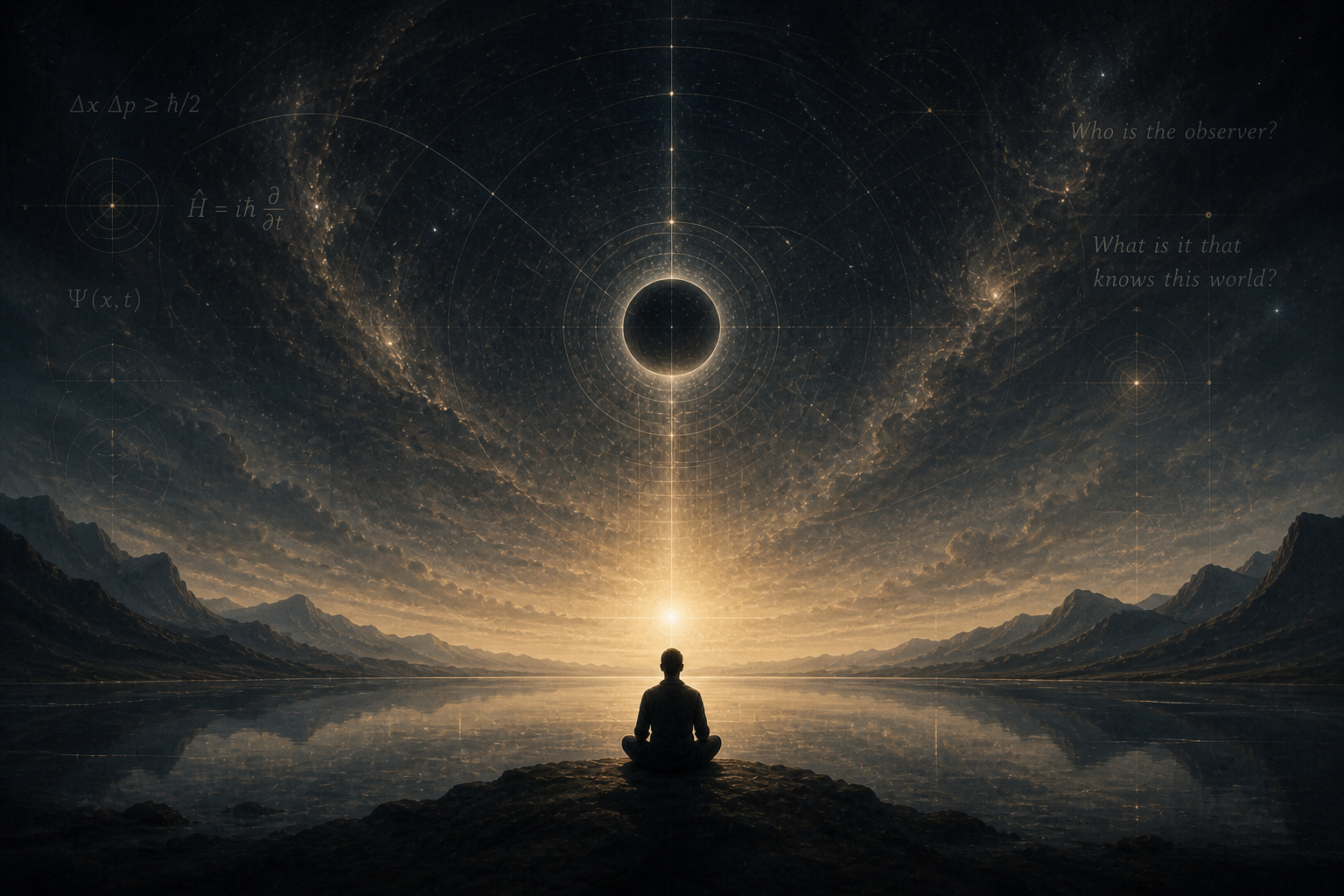
Argument 1: The Question Physics Cannot Answer From Inside Physics, Why?
Every experiment in quantum mechanics requires a specification of measurement — which introduces the question of the observer.
Not metaphorically. Not as a poetic flourish. The mathematical formalism of quantum mechanics — the Schrödinger equation, the Born rule, the measurement problem — cannot be closed without specifying what counts as a measurement, which means specifying what counts as an observer.
Physics can describe what happens to a system when it is observed. It cannot tell you what observation is.
That boundary is not a temporary gap waiting to be filled by better instruments or faster computers. It is structural. It arises from the formal separation between unitary evolution and measurement in the theory itself. The observer is the one thing the physical description cannot step outside of to examine.
Vedanta starts exactly here.
Not as a workaround. Not as mysticism filling the gaps science leaves open. But because this question — what is the one who knows? — is the central question of the entire tradition. Every Upanishad, every Acharya Shankara commentary, every line of Sri Aurobindo’s epistemology is circling this.
The coincidence is worth examining carefully.
That is what Essay 2 does.
Argument 2: What Happens When You Try to Find the Observer
Try this once.
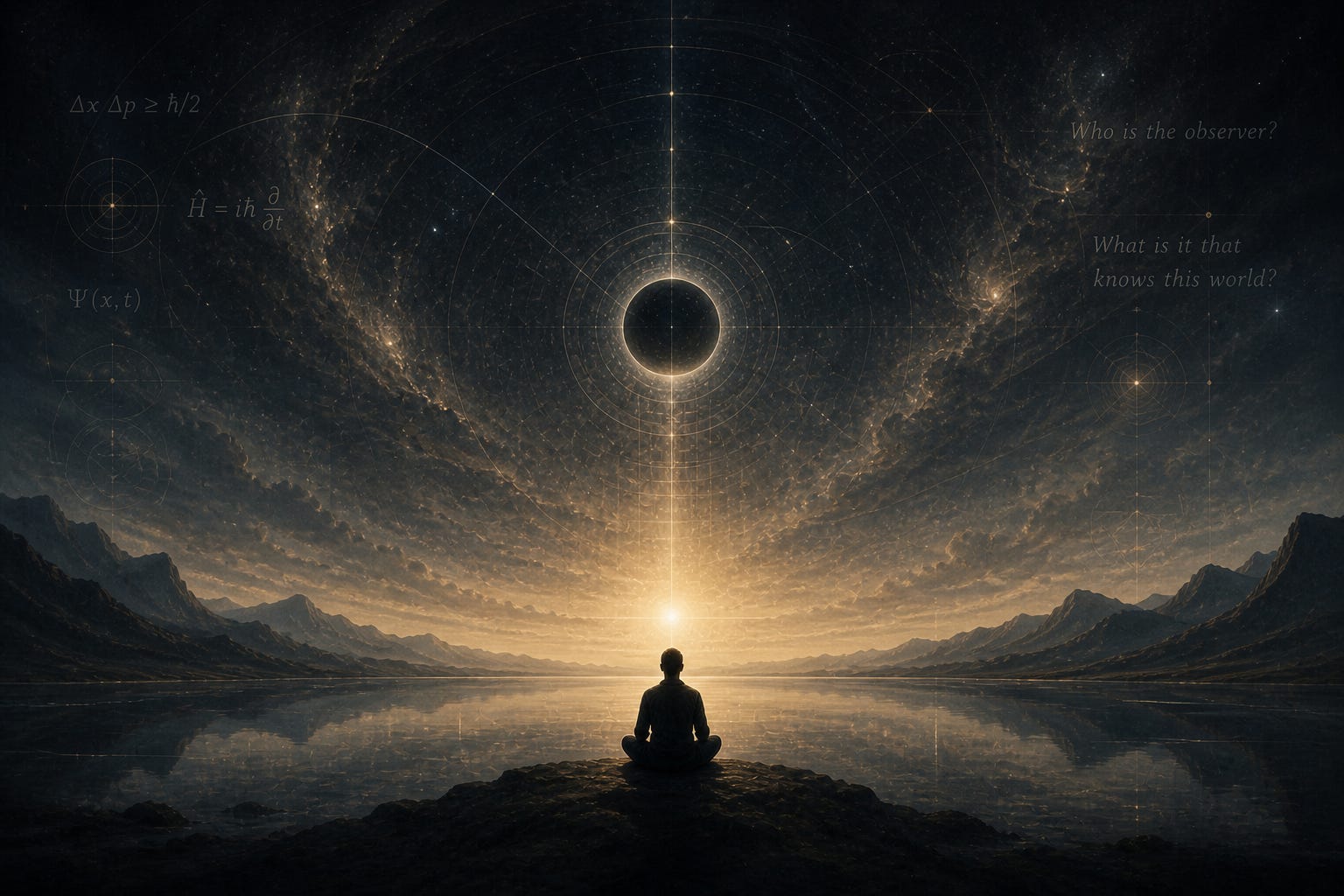
You are reading these words. Something is aware of them. Call that awareness the observer.
Now try to find it.
You look inward — and you find thoughts. Sensations. A mild self-consciousness about the act of looking. But the thing doing the looking? It is always one step behind whatever you are examining. The moment you try to make it an object of investigation, it has already moved. It is the eye that cannot see itself directly. The lamp that illuminates everything in the room but cannot shine on its own source.
This is not a failure of introspection. It is a structural feature.
The Mandukya Upanishad calls the pure witness Turiya — the fourth, the one that underlies and pervades the waking, dreaming, and deep sleep states without being reducible to any of them.
…अद्वैतं चतुर्थं मन्यन्ते विवेकिनः । सः आत्मा सः विज्ञेयः ॥
…He Who is unseen and incommunicable, unseizable, featureless, unthinkable, and unnameable,Whose essentiality is awareness of the Self in its single existence, in Whom all phenomena dissolve,…Who is the One than Whom there is no other, Him they deem the fourth; He is the Self, He is the object of Knowledge.
Western philosophy calls this the subject-object asymmetry. Kant called it the transcendental unity of apperception. Husserl built phenomenology around it.
The problem is identical across traditions. The observer cannot be fully captured within any system it itself generates.
Quantum mechanics hit this wall in 1927. Vedanta had been mapping it for three thousand years.
Argument 3: The Observer in Physics — A Precise Problem, Not a Vague One
It is worth being exact about what the measurement problem actually says.
In quantum mechanics, a particle does not have definite properties — a definite position, a definite spin — until it is measured. Before measurement, it exists in a superposition: a weighted combination of all possible states. The Schrödinger equation describes this superposition evolving smoothly and deterministically over time.
Measurement collapses it. One outcome becomes actual. The others vanish.
The problem: The Schrödinger equation describes continued superposition. The transition to a definite outcome is not derived from it. So something outside the equation is required to explain why measurement produces a definite result.
That “something” is what different interpretations identify differently — often in terms that implicitly or explicitly invoke an observer.
Various interpretations — Copenhagen, Many-Worlds, QBism, objective collapse theories — are essentially different answers to the question: what is the observer, and what precisely does observation do?
None of these interpretations is universally accepted. The debate is live. After nearly a century, physicists still disagree about what their own most successful theory is actually saying about the nature of reality.
The observer problem in quantum mechanics is not a philosophical garnish on top of settled physics. It is unsettled physics.
This matters. Because it means the question Vedanta has always asked — what is the nature of the witness? — is not merely a spiritual question. It is also a foundational scientific one.
Argument 4: What Vedanta Means by the Observer
Vedanta does not use the word “observer” the way physics does.
In physics, the observer is often treated as a measuring apparatus — something that interacts with a quantum system and produces a classical record. In more careful interpretations, it becomes a conscious agent. But even then, consciousness is usually treated as an emergent property of sufficiently complex matter.
Vedanta reverses the explanatory order.
In Advaita Vedanta — the non-dual school articulated most rigorously by Shankara in the 8th century — consciousness is not produced by matter. Consciousness is the ground. The witness, Sakshi, is not a feature of the brain. It is the irreducible fact of awareness itself, prior to any object it is aware of, prior to the body that seems to house it.
The Kena Upanishad states it directly:
यस्यामतं तस्य मतं… (Kena Upanishad 2.3)
“It is unknown to those who think they know it; known to those who do not.”
The observer cannot be made into an observed without ceasing to be the observer.
Sri Aurobindo takes this further. For him, the witness is not merely a passive screen. It is the evolutionary point at which consciousness begins to recognize its own nature — moving from what he calls the Inconscient, through the half-aware vital and mental planes, toward what he terms the Supermind: a level of consciousness where knowledge and being are no longer split, where the observer and the observed are not structurally divided.
This is a philosophical claim. A precise one. Not a feeling. Essay 2 examines whether it holds.
Argument 5: The Wigner’s Friend Problem — Where Physics Gets Genuinely Strange
In 1961, physicist Eugene Wigner proposed a thought experiment.
Wigner’s friend is in a laboratory, observing a quantum particle. From inside the lab, the measurement happens — the wave function collapses, a definite result is recorded. From outside the lab, however, Wigner himself sees the entire system — friend, particle, laboratory — as a quantum superposition, still uncollapsed.
Two observers. Two incompatible descriptions of reality. Both, within their respective frames, correct.
The question this raises: is there an observer-independent reality at all? Or does reality only ever exist relative to an observer?
This is not a fringe position. The Wigner’s Friend problem has been extended and formalized in recent decades — most notably in work by Časlav Brukner and the theoretical framework of QBism developed by Christopher Fuchs. The conclusion some physicists are now willing to state plainly: some interpretations now suggest quantum mechanics may be fundamentally a theory about the relationship between observers and systems, not a description of an observer-independent world.
That is a staggering philosophical concession.
It is also, almost word for word, what Advaita Vedanta has maintained about the nature of Maya — not that the world is illusion in the sense of being unreal, but that the world as we experience it is always already structured by the consciousness that encounters it.
Wigner’s Friend did not prove Vedanta. But the structural rhyme is precise enough to deserve more than a footnote.
Argument 6: What Sri Aurobindo Adds — A Difference in Philosophical Aim
Acharya Shankara’s Advaita does not begin with the world. It begins with the error in how the world is known.
The central problem is not cosmological, but epistemic: a misidentification of the self with what it is not. The individual takes itself to be a finite observer located within a world of objects, when in fact the true self — Ātman — is identical with Brahman, the non-dual ground of all appearance.
Māyā, in this framework, is not a defective theory of the world. It is a precise account of misapprehension — how the non-dual appears as divided through adhyāsa (superimposition). The task is not to explain the unfolding of the universe, but to dissolve the ignorance that makes such an unfolding appear ultimately real.
Liberation (mokṣa) is therefore not a culmination in time. It is the immediate correction of a fundamental error. From this standpoint, the observer was never truly an entity within the system it seeks to understand.
Within its chosen scope, nothing is left unresolved. The apparent “gap” — why the universe exists, why it evolves — is not treated as a defect, because the framework is not oriented toward explaining becoming, but toward dissolving misidentification.
Sri Aurobindo takes the world-process as requiring explanation at the level of ultimate reality, rather than bracketing it as empirically valid but not ultimately real.
His question is not: Who is the observer, really?
It is: What is the meaning of this vast process in which consciousness appears to unfold?
He proposes that consciousness is not only the ground of being, but also the principle of manifestation. Through involution, it descends into apparent inconscience; through evolution, it progressively re-emerges — matter to life to mind to Supermind.
In this framework, the observer is not merely a mistaken identity to be corrected. It is a stage in a real process — the point at which the universe begins to become aware of itself in form.
The observer, here, is not only to be dissolved into the Absolute, but to be understood as part of the Absolute’s own dynamic articulation.
This is not a correction of Acharya Shankara, but a reorientation of the question:
- Acharya Shankara asks: What is ultimately real, once error is removed?
- Sri Aurobindo asks: Why does reality appear as a process of becoming at all?
One resolves the status of the observer by negating its apparent limitation.
The other situates the observer within a larger movement through which limitation itself becomes expressive.
They do not stand in contradiction. They operate on different philosophical axes:
- one dissolves the problem of the observer
- the other retains the problem and expands its scope
Together, they demonstrate that the question of the observer admits of more than one rigorous philosophical orientation — each internally coherent, each approaching a different dimension of the same problem.
Essay 2 maps both positions — Shankara’s and Aurobindo’s — and asks which one the physics is actually rhyming with.
Argument 7: Why This Question Matters Beyond Philosophy
You could read all of this as an interesting theoretical exercise.
Two ancient traditions and one century-old physics problem happen to be asking similar questions about the nature of the observer. Noted. Intriguing. Now what?
Here is why it matters practically.
The dominant assumption in contemporary neuroscience, cognitive science, and AI research is that consciousness is what the brain produces — an emergent phenomenon, a late evolutionary development, a side effect of sufficiently complex information processing. On this view, the observer is a biological construct. Useful. Temporary. Ultimately reducible.
If that assumption is correct, the implications run in one direction: consciousness is a tool, potentially replaceable, certainly explainable without remainder once neuroscience matures.
If the Vedantic framework is closer to correct — if consciousness is not produced by matter but is instead the precondition for any experience of matter at all — the implications run in an entirely different direction. The observer is not a tool. It is the ground. And any science that excludes it from its own foundations is building on an unexamined assumption that may prove, eventually, to be its most significant error.
This is not an argument against neuroscience. It is an argument for philosophical honesty about what neuroscience’s methods can and cannot reach.
The observer problem in quantum mechanics has forced physics to at least ask the question. That opening is rare. It should not be closed prematurely by disciplinary habit or by the comfortable assumption that we already know what consciousness is.
Vedantum exists in that opening.
This sequence leads into a longer inquiry into the nature of the observer at the limits of physics.
Read → What Is the Observer — Quantum Mechanics and Vedanta at the Same Wall
Leave a Reply